
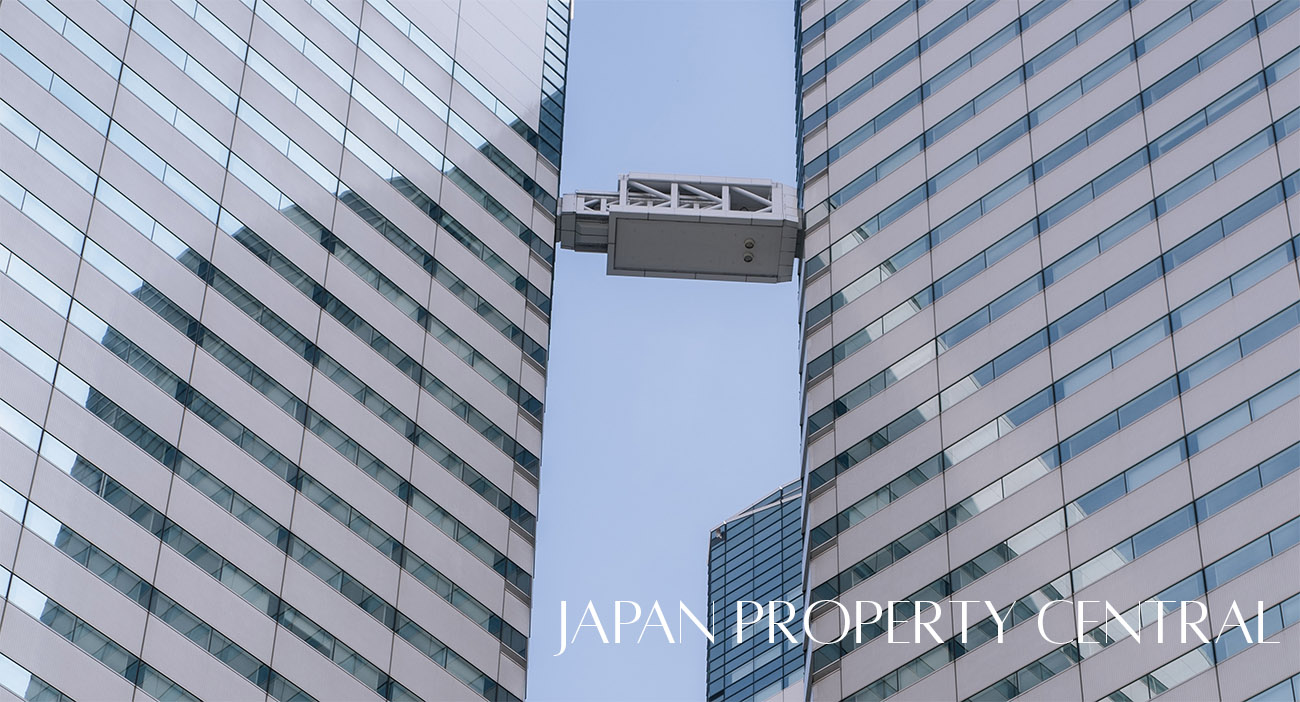
News broadcaster NHK has now picked up on the struggling office market conditions around Tokyo Bay, particularly Harumi island. Of interest is the Harumi Island Triton Square office complex. The landmark project was completed in 2001 with a shopping mall inspired by Southern Europe. Above, there are four office blocks with a total floor area of 383,300 m2 (4.1 million sq.ft).
Office occupancy was great up until five years ago, with some of the towers fully leased up. Now, there is around 10,000 tsubo or 33,000 m2 of vacant space. One of the office towers has a vacancy rate of 20%.
Tokyo’s bayside islands, including Harumi, Tennozu Isle, and Shinagawa Seaside, and Daiba, were originally heavy industry, warehouses and newly-created reclaimed land, but began to see a transformation into office centers from the early 2000s. Tenants were often in tech-related industries.
Tokyo itself has as robust office market and most districts have low vacancy rates. According to Sanko Estate, the vacancy rates on large-scale office buildings with floor plates of above 200 tsubo (660 m2) in January 2024 were 1.36% in Shibuya/Dogenzaka, 1.15% in Shinjuku/Kabukicho, 2.22% in Nihonbashi, 2.25% in Marunouchi/Otemachi, and 7.09% in Toranomon/Shimbashi. Meanwhile, the areas closer to the waterfront had vacancy rates in the double-digits, including Hamamatsucho/Takanawa with 13.1%, Kita Shinagawa/Higashi Shinagawa with 11.91%, and Higashi Nihonbashi / Shinkawa (incl. Harumi) with 10.54%.
NHK posits that the reason behind the high vacancy in these bayside districts is due to a change in office demands from IT tenants brought about by the pandemic. The rise in remote work saw fewer staff in the office and less of a need for large floor space. Those tenants began relocating to smaller offices in more convenient locations in central Tokyo. In addition, employers are becoming aware that they need to provide workspace in more desirable locations and better environments in order to stand out in an increasingly competitive labor market. Companies are also showing a preference for buildings with the latest in security and access features, and with spaces such as lounges that encourage communication.
Some landlords with older, out-dated buildings facing growing vacancies are upgrading lobbies, elevator hallways, and adding shared lounges in order to meet tenant needs. Some are offering free rent and other incentives.
Source: NHK, February 14, 2024.